| Written by Deborah Kolb, Judith Williams, and Carol Frohlinger |
| Tuesday, 14 April 2009 20:22 |
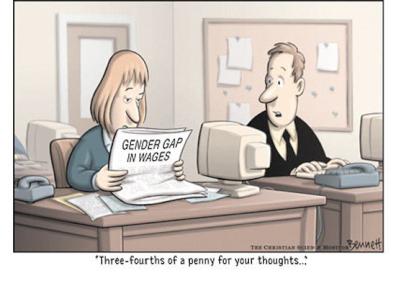
Women are winning the numbers game in the workforce. They now fill almost half of the country’s managerial jobs. In 1999, about 60% of females, 16 years of age or older, worked outside the home, up from 20% at the turn of the century. Source: Business Week Source: US Department of Labor Source: US Department of Labor Given the data, it’s surprising to discover that by a good margin most female managers think they have reached wage parity with their male colleagues. The statistics are sobering: 70% of female executives think they’re paid as much as males; 78% of men agree. The facts, however, show that women in management take home only 62.7% of what male managers earn (Source: Gallup, American Management Association). Realities and Myths Behind the Persistent Wage GapLike all entrenched patterns, the gender gap in wages is supported by both myth and reality. Some of the realities behind the differential require policy changes at the highest levels.
The Cumulative PriceContrary to folk wisdom, women are just as likely as men are to negotiate compensation. The problem is, they don’t realize the same results from their efforts. When men negotiate an entry salary or a raise, they achieve on average a 4.3% increase from the initial figure. By contrast, when women negotiate, they realize only 2.7% more. This gap adds up.Over the span of a career, the lag translates into about a 35% wage differential that can be traced back to starting salaries. According to a recent study, if current wage patterns continue, a 25-year-old woman, who works full time, will earn $523,000 less than the average 25-year-old man will by the time they both retire at 65. That’s a lot of money. But the discrepancy affects more than a bank account or financial security. Salaries are important. They are a good index of the value an organization puts on your skills and contributions. In turn, they shape an individual’s notion of self-worth. Narrowing the GapWhat can an individual woman do when she bumps up against the wage gap? Plenty.
|
welcome
Rabu, 07 Juli 2010
Confronting the Gender Gap in Wages
Senin, 28 Juni 2010
The Gender Pay Gap--New Opportunities for Women
Here's one more: unintended results from business school researchers have provided more insight into the decades-old discussion of why men earn more than women.
Kevin Clark and Patrick Maggitti of Villanova University and Holly Slay of Seattle University looked to research relationships among business networks. They were not targeting gender or potential impacts gender might have. But gender did have an impact in workplace relationships--an impact they could not ignore. Especially when the impact was on pay.
The State of Affairs
According to the Census Bureau, among full-time workers age 25 or older in 2007, women earned an average of $33,759 which was 24% less than the $46,788 average for men.
Are Men Better Brown-Nosers?
The group looked at the influence of relationships that are 360 degrees around an employee--superiors, peers, and subordinates. It found that men build stronger relationships in all three situations which lead to an increased wage gap between men and women. Researchers controlled for starting salaries, job level, and industry.
Relationships with subordinates had the greatest perceived impact on pay. In other words, if you connect with those below you, they will perform well, make you look good to your boss, and you get a raise. But this trail didn't exist for women.
"We speculate that in some cases, men that are bosses make stronger attachments to the male employees," said Maggitti. "You get along better with people who are similar. That's one potential explanation."
So it makes perfect sense when the men are talking about last night's game or the upcoming tee time at a fancy golf course, women don't necessarily fit in. And even if they can talk the talk, it's just not the same.
Good News for Women
The researchers did not want to cast more gloom and doom over the gender gap--an area that is squarely in public discourse at the moment. Instead, the researchers want their study to be used as a way to identify opportunities for women to rectify pay inequities. They suggest:
- Motivate and get to know your team: Maggitti and Clark acknowledge that women are better than men at establishing group consensus and managing teams. But that's only in studies and on paper. When it comes to managing subordinate networks, women need to improve.
- Find out what your friends know: Maggitti and Clark say women are aware of their work communities and groups but don't use peers in obtaining information to advance their careers. Women need to start thinking of it as opportunity to share company information related to the work at hand, rather than gossip.
- Influence your supervisor: Researchers suggest taking advantage of chance run-ins with the boss by having something ready to say. Yes, when your boss is a man, and you're a woman, you won't have those bathroom run-ins. There's always the hallway.
Next Steps
Like many academic studies, results often spark ideas for future research. The folks behind the study hope to revisit the gender of all the people involved in all workplace relationships--the bosses, the peers, and the subordinates; not just the person at the center. They want to look at the perception of the "old boys club" network--does it still exist? But in the meantime, they hope that women will recognize and create opportunities that may exist right now in the workplace.
careers, Jobs Indonesia, Indonesia Vacancy